[By Mesfin Ayenew, Dessie, Wello]
The main aim of this article is to promote unity among Ethiopia’s various ethnic groups. It aims to correct misconceptions about liberation fronts, self-determination of ghetto politics of the TPLF and others, the United Nations, and international law.
While the focus is on the people of Ethiopia, residents of the broader region (“Horn of Africa”) have faced severe hardships and are among the most impoverished and oppressed populations worldwide. In writing this article, the goal is not to add to the suffering of a people engaged in a life-and-death fight against oppressive regimes that have historically committed acts of murder, imprisonment, torture, abuse, and displacement.
“Do you know about the Djibouti–Somalia proposal to Ethiopia, which aimed to persuade Ethiopia not to recognise Somaliland?
This proposal is said to have prompted Hassan Sheikh Mohamud and Ismaïl Omar Guelleh to request two meetings (and a third involving Djibouti) within three months.
The proposal allegedly involved withdrawing and rearranging the borders in the Horn of Africa among the three countries.
Under this plan:
- Djibouti would become a fully Somali country, gaining land from Sitti, Harawo, and Awdal (covering all Issa and Gadabuursi territories).
- Ethiopia would receive the Afar regions of Djibouti, giving it access to the sea.
- The Hawd, Reserved Area, and Ogaden would be returned to Somaliland, which would then be forced to join Somalia’s military.
In their view, everyone would gain something.
The proposal reportedly leaked to the media and has been implicitly mentioned by Abubakar Baale at the UN and by Osoble on Facebook.
It is also said to be linked to the maps attached to the “Xeet Ciise” submission to UNESCO, which was allegedly approved by Djibouti, Ethiopia, and Somalia.” (@guntigaab, 28/03/2026, https://x.com/guntigaab/status/2038011502578291075?s=48&t=tUkyqQPhvthROZkj0xxtUQ)
Ethiopia has a long-standing and rightful claim, recognized under international law and tradition, to its entire coastal area, including the beautiful Dahlak Islands and the Afar region bordering Djibouti. No international organization or third-party country pursuing personal interests has any genuine authority or right to unlawfully interfere with or deny these rights by force or any other means.
Furthermore, international peace, prosperity, and the harmonious coexistence of nations and the people worldwide have faced significant challenges due to actions by the United States (in alliance with NATO) and the former Union of Soviet Socialist Republics (Eastern Bloc) over the past fifty years. From 1946 to 1998, the USSR used its veto power in the Security Council 116 times, while Western countries collectively exercised vetoes 120 times (the United States – 72, the United Kingdom – 30, and France – 18).
I believe that Every individual possesses complementary economic potential and significant personal worth, which can be promptly mobilized for the collective benefit. In this article, we emphasize principles that have been distorted, historical relationships that have been neglected, and long-standing community life that has been disrupted — all primarily due to the selfish pursuits of so-called liberation front leaders.
The best remedy is closer than we all think. Even after 50 years of working with international organizations and in diplomacy and investing heavily in development programs, we haven’t seen the improvements we hoped for. Sadly, our situation has even become more challenging than what our parents faced. Many of the issues discussed here are connected to key ideas in international law. I truly believe that the history and growth of international law demonstrate that norms (natural law) and rationality are essential guides for us.
Mussolini’s “Legge Organica” or “Basic Law” or Charter and Constitution, drawn up for the conquered Ethiopia in June 1936, was an instrument of “divide et Impera” following Prochazka’s strategy of tribal dismemberment. According to Mussolini’s “Legge Organica” Ethiopia was divided into five tribal units:
1. Governo dell’Eritrea (including Tigray)
2. Governo dell’ Amhara
3. Governo dell’ Harar
4. Governo dei Galla e Sidama
5. Governo Della Somalia (capital Moqadisho, including Italian Somaliland, the Ethiopian Ogaden, the southern lowlands of Bale, Sidamo and Boran.)
Let us now examine Mussolini’s five tribal governments one by one and compare them with the CIA-TPLF’s ethnic policy to discern similarities and differences. We will see in several instances that the CIA-Weyane have carried the tribal dismemberment of Ethiopia and the crime of ethnic cleansing, massacres, and mass deportation to a much higher stage than was even contemplated by Mussolini.
II. Fascist Governo of Eritrea (1936-41)
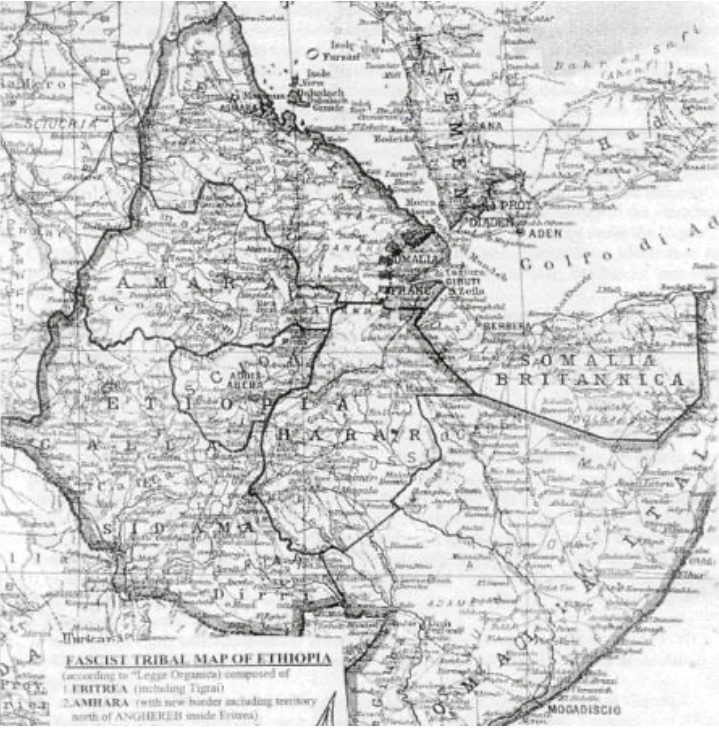
Being the “primo genito” and being the most trusted region, the Governor of Eritrea was probably the most important Fascist personage in the colony, more important even than the viceroy in Addis Ababa, as we will have occasions to see. He was called “Gran Governatore”. Tigray was governed as part of Eritrea. Although nominally under the Governor of Amhara, Shoa, as we shall see, was under the Gran Governatore of Eritrea. The “Governo” of Eritrea was divided into the following “Commissariati” until July 1939: There was no independent “Governo” of Tigray. Tigrai was broken up into several “commissariati” of Eritrea, namely Western Tigray, Agame, Enderta, and Tembien:
1. Hamasien (Asmara) with Residenza in Asmara
2. Serae (Addi Ugri) with Residenza at Addi Ugri and Vice-residenza at Addi Quala
3. Akle Guzai (Addi Qaieh) with Residenza at Addi Qaieh and Vice-Residenza at Arafali and Deqe Mehari
4. Eastern Lowland (Massawa) with Residenza at Massawa and a vice-residency at Ghinda
5. Western Lowland (Agordat) with Residenza at Agordat, Barentu and Tessenei, and Vice-Residenza at Om Hagere
6. Western Tigray (Adowa) with the
- Residenza of Adowa,
- Residenza of Axum,
- Residenza of Ende Sellassie, Ad Daro, Enticcio,
7. Adigrat (Agame) with Residenza at Adigrat, Hausien, Azbi, and Vice-Residenza at Agula and Au
8. Mekele (Enderta) with Residenza at Mekele,
9. Tembien (Abbi Addi) with Residenza at Abbi Addi, Samre, and Abergalle
10. Dancalia (Assab) with Residenza at Assab
As Del Boca says, “What immediately appears evident, from an analysis of the territorial division of these governments (done with excessive haste), is the punitive concept which has inspired the legislator.” The Ethiopian Empire has been dismembered, recomposed on a predominantly tribal basis, and rendered unrecognizable.” The Fascist propagandist Professor Raffaele di Lauro wrote: “The choice of the capital of each tribal government and the border demarcation of the five component territories have been decided following a clear political criterion, that is to say, consideration of political opportunity and verification of an unfailing positive result. The legislator has made everything possible to keep strictly to the principle of uniting under one government people of the same linguistic, ethnic, and historical identity.”
It is important to have some historical perspective as background to understand how things evolved over the last 625 years, leading to a great war between Somalia and Ethiopia, between Amhara and Tigray, between Eritrea and Ethiopia, and between Tigray and Ethiopia.