By Dr. Dawit Tesfay, Institutional Policy & Post-War State-Building Researcher, HORN OF AFRICA GEOPOLITICAL REVIEW (HAGR)
“Throughout history, the most brutal laws were not written to deliver justice. They were written to make resistance unthinkable.” — Dr. Dawit Tesfay
Executive Summary
This analysis is not a polite academic exercise. It is an indictment. What the Tigray People’s Liberation Front (TPLF) has constructed in twenty-first-century Tigray—under the banner of liberation, under the cover of wartime emergency, under the fiction of legitimate regional governance—belongs in no democratic legal tradition and in no post-colonial governance framework. It belongs in the historical catalogue of the world’s most barbaric experiments in punitive control. This document places it there, precisely, without apology, and without the softening language that political sensitivity sometimes demands.
The TPLF is a dying political-military organism executing its most destructive phase: the death spiral. And like all authoritarian movements facing terminal decline, it is doubling down on the one instrument that has always defined it — not governance, not development, not justice, but raw, unmediated punitive power over a captive population. What follows is a systematic analysis of that power: its historical genealogy, its contemporary application, and its ultimate trajectory toward a collapse that the Tigrayan people have already earned the right to survive.
The Death Spiral — Anatomy of a Regime in Its Final Phase
Last-Ditch and Lethal: What a Dying Regime Does to Its Own People
Political movements facing irreversible decline do not simply recede. They lash out. They tighten their grip precisely when that grip is losing its structural basis. They prosecute and imprison more aggressively precisely when their legitimacy has evaporated. They deploy maximum violence precisely when they have the least political justification for doing so. This is the death spiral of authoritarian movements — and the TPLF, as of this writing, is in the middle of one.
The evidence is visible in every dimension of TPLF governance. The Pretoria Agreement of November 2022 — which should have provided a managed pathway toward political normalization, civilian governance restoration, and the integration of armed forces under federal command — has been systematically subverted. The Interim Regional Administration of Tigray (TIRA), the legitimate transitional governance body established under the agreement, has been bypassed, humiliated, and in multiple documented instances physically expelled from its operational territories by TPLF-aligned military commanders. The Tigray Defense Forces (TDF), which under Pretoria should have undergone genuine disarmament, demobilization, and reintegration (DDR), remain a parallel armed structure loyal to TPLF hardline commanders rather than to any constitutional authority.
This is not governance. It is an occupation—and the occupied population is the TPLF’s own people. That is the defining obscenity of the current moment in Tigray: a political movement originally formed to liberate Tigrayans from external domination has reconstituted itself as the primary instrument of Tigrayan subjugation. The liberator has become the jailer. The freedom fighter has become the warden. And it enforces its warden authority through a legal architecture that would not be out of place in the darkest chapters of human legal history.
The TPLF’s criminal code does not govern Tigray. It holds Tigray hostage — and shoots the hostages who ask why.
Semi-State Terrorism: The TPLF’s True Institutional Category
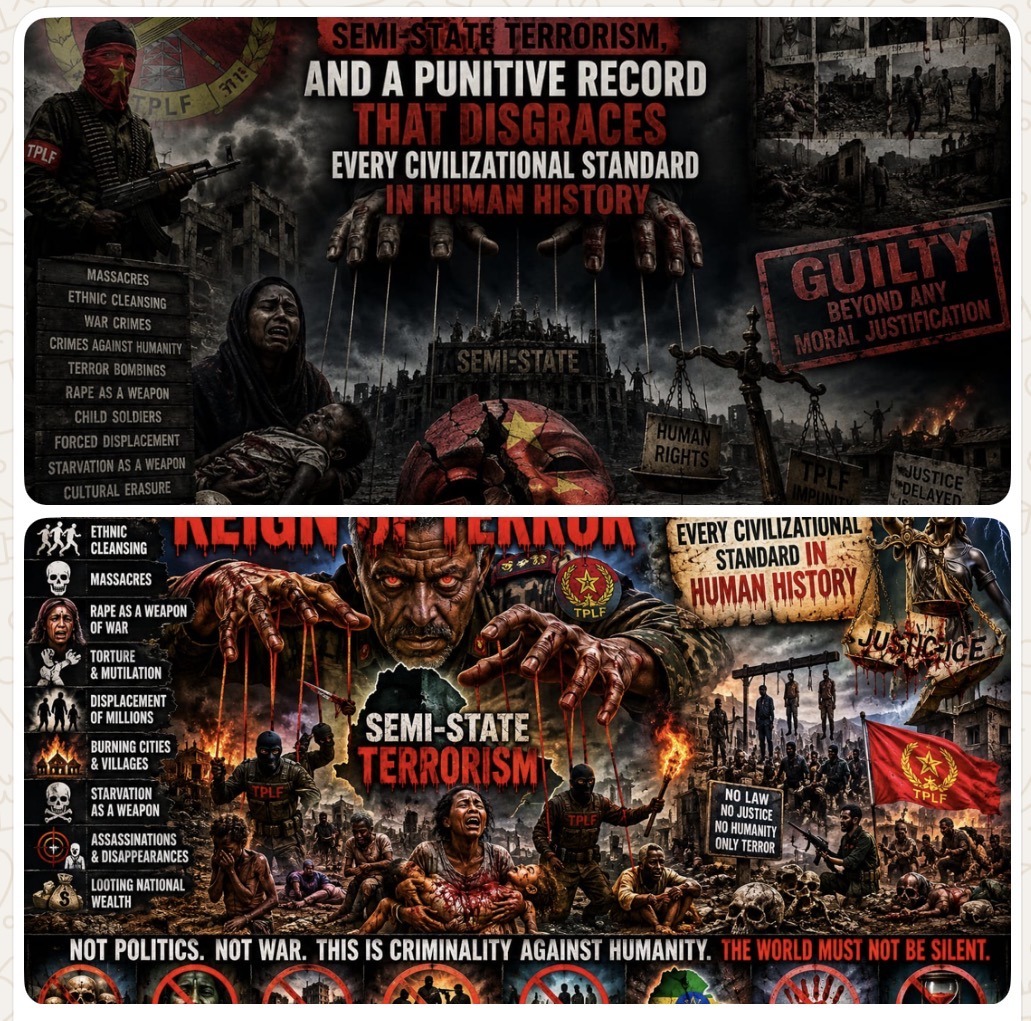
It is analytically important — and politically necessary — to name what the TPLF actually is in its current configuration. It is not a government. It is not a political party. It is not even a conventional armed group. The TPLF today fits the precise definition of what security scholars call a Terrorist Semi-State (TSS) or semi-state terrorist organization: an armed militant structure that controls defined territory, administers civilian populations, and sustains the formal architecture of governance—courts, laws, administrative councils, and economic regulations—while simultaneously deploying systematic violence as the primary instrument of political control.
The distinguishing characteristic of a terrorist semi-state is the fusion of governance and terror: the state’s administrative apparatus becomes the delivery mechanism for terror, and terror becomes the governance instrument. Laws are not promulgated to regulate social behavior in the public interest. They are promulgated to define the boundaries of permissible existence—and to provide judicial cover for eliminating those who transgress those boundaries. The court is not an institution of justice. It is a processing facility for the permanent removal of political threats.
By every criterion of this analytical category, the TPLF qualifies. It controls territory. It issues laws. It administers a civilian population. It maintains administrative councils. And it uses all of these institutional mechanisms as instruments of a systematic terror campaign against any Tigrayan who represents an alternative—intellectual, political, or organizational—to TPLF dominance.
The TPLF is not a government that sometimes behaves badly. It is a terrorist semi-state that sometimes issues administrative paperwork. The distinction is not semantic. It determines what legal framework, what international accountability mechanism, and what political response is appropriate.
A Record That Shames History — Contextualizing TPLF Punitive Law
The Historical Catalogue of Human Legal Barbarity
History has produced legal systems of extraordinary cruelty. From ancient Babylon to Stalinist Moscow, from medieval Europe to apartheid South Africa, human political authority has repeatedly discovered that the most efficient short-term instrument of social control is terror — institutionalized, legally codified, publicly visible terror. What follows is not a catalogue produced for shock value. It is a comparative framework against which the TPLF’s legal architecture must be assessed—and by which its practitioners must be judged.
The Code of Hammurabi — Retributive Justice as Class Weapon (c. 1750 BCE)
Ancient Babylon’s famous legal code established the world’s first comprehensive written law—and with it, the world’s first documented system of retributive justice calibrated by social class. If a builder’s structurally deficient house collapsed and killed the owner, the builder was executed. If the collapse killed the owner’s son, the builder’s son was put to death—a principle of collective punishment for family membership that history would see repeated, most lethally, under Stalin. The Code of Hammurabi’s innovation was not merely its harshness but its systematization of harshness: cruelty organized, categorized, and made predictable. The law’s severity was its message; its publicity was its threat.
Drakōn’s Code — Written in Blood (621 BCE)
Athens’ first written law code, promulgated by the legislator Drakōn in 621 BCE, remains the etymological source of the word that most precisely describes both historical and contemporary authoritarian legal excess: draconian. Drakōn prescribed death for virtually every offense—theft, idleness, and minor civil infractions—and when later asked why, replied that minor offenses deserved it and he could devise nothing worse for greater ones. It is a reply that captures, with alarming precision, the intellectual framework of every punitive authoritarian system that followed: the elimination of proportionality from punishment as a statement of absolute sovereign authority. When the Athenian statesman Demades observed that Drakōn had written his laws not in ink but in blood, he was identifying the essential logic of the code: not deterrence, not rehabilitation, not justice, but demonstration of lethal power.
England’s Bloody Code — Two Hundred Ways to Die (18th–19th Centuries)
Between the 17th and 19th centuries, England accumulated over 200 capital offenses under what historians call the Bloody Code—a legislative monument to the paranoid cruelty of a propertied class determined to protect its assets through maximum violence. Pickpocketing an item worth a shilling: death. Stealing a sheep: death. Cutting down a young tree in an orchard: death. The Bloody Code’s defining characteristic was the grotesque disproportion between offense and punishment—a disproportion that served not judicial but political purposes. It was a statement by the powerful to the powerless: your lives are worth less than our property, and the law exists to protect the latter, not the former.
Stalin’s Law of Spikelets — Criminalizing Survival (1932)
On August 7, 1932, at the height of a state-engineered famine that would kill millions across the Soviet Union — including the Holodomor genocide in Ukraine — Joseph Stalin’s regime promulgated what became known among the starving peasantry as the Law of Spikelets. The law declared all collective farm crops to be state property and prescribed death by firing squad — with confiscation of all remaining personal property — for stealing so much as a handful of grain from harvested fields. No exceptions were made for age: children as young as twelve were prosecuted, imprisoned, and in documented cases executed for the crime of attempting to feed themselves. If mitigating circumstances existed, the sentence could be commuted to a minimum of ten years in the Gulag, with no possibility of amnesty. Within eighteen months, more than 200,000 Soviet citizens had been convicted under this law. The millions who died of famine during the same period died in part because the law had criminalized the act of survival.
Stalin’s broader punitive architecture is worth noting in this catalogue. NKVD Order No. 00447 formalized the Great Terror through regional execution quotas: local secret police officials were assigned minimum numbers of citizens to arrest, execute, or deport, with the understanding that exceeding the quota demonstrated revolutionary vigilance while falling short suggested ideological unreliability. The quotas were routinely exceeded because local officials competed to demonstrate their loyalty. Hundreds of thousands of completely innocent people were executed or sent to the Gulag not because of any act or belief but because they were counted in someone’s quota.
Nuremberg Laws — Legal Architecture of Genocide (1935)
Nazi Germany’s Nuremberg Laws of 1935 represent the modern era’s most complete example of law as an instrument of systematic dehumanization. The laws stripped Jewish Germans of citizenship, prohibited marriage and sexual relationships between Jewish and non-Jewish Germans, and established a comprehensive legal framework for the social isolation, economic exclusion, and eventual physical elimination of an entire population. What made the Nuremberg Laws uniquely horrifying was not merely their content but their form: they were meticulously drafted, formally published, administered through conventional bureaucratic mechanisms, and enforced by a functioning judiciary. They were the legal groundwork for the Holocaust—the most systematic mass murder in recorded history—and they were presented to the German public and the international community as legitimate legislative acts of a sovereign state.
Apartheid Legislation — Institutionalized Dehumanization (1948–1994)
South Africa’s apartheid legal system, constructed between 1948 and its formal abolition in the early 1990s, institutionalized racial hierarchy through hundreds of legislative acts that regulated every dimension of human social existence: where people could live, work, travel, be educated, receive medical treatment, and die. The system’s defining characteristic was its totality: there was no sphere of human life that apartheid law did not penetrate and regulate according to racial classification. Its enforcement machinery—the pass laws, the Group Areas Act, and the Suppression of Communism Act—was designed not merely to segregate but to break the will of the majority population through the cumulative weight of daily, inescapable legal humiliation. History’s cruelest laws share a single defining characteristic: they were not written to deliver justice. They were written to make the exercise of power costless to those who hold it and catastrophic to those who challenge it. The TPLF has written exactly such laws.
The TPLF’s Legal Architecture — Where It Sits in This Catalogue
Cruel, Unusual, and Unprecedented: The TPLF’s Punitive Record
Against the historical catalogue above—Hammurabi, Drakōn, the Bloody Code, Stalin’s Law of Spikelets, the Nuremberg Laws, and apartheid—the TPLF’s legal architecture must now be placed and assessed. That assessment yields a conclusion that should disturb every observer of Horn of Africa politics, every international human rights institution, every member of the African Union, and every signatory to the Pretoria Agreement: the TPLF’s current penal framework is not merely harsh. It is structurally aligned with the worst examples of punitive governance in human history, applied to a post-conflict civilian population that has already survived one of the most devastating regional wars of the twenty-first century.
Death for Dissent: The Capital Crime of Political Disagreement
The TPLF’s wartime criminal code—never formally rescinded despite the Pretoria Agreement—prescribes the death penalty for a range of offenses defined with deliberate vagueness. Refusal to perform military service — a category broad enough to encompass conscientious objection, medical incapacity, or simply the decision of a farmer to tend his fields rather than report to a recruitment point — is a capital offense. Collaboration with the enemy—a category whose definition the TPLF reserves the right to determine unilaterally and which in practice encompasses any contact with federal government representatives, any cooperation with TIRA officials, and any communication with Ethiopians outside TPLF-controlled territory—is a capital offense. Acts deemed to undermine national unity—a formulation capacious enough to absorb any form of independent political thought, any criticism of TPLF leadership, or any advocacy for political alternatives—carry penalties ranging from lengthy imprisonment to death. This is Drakōn’s logic applied to twenty-first-century Tigray: the elimination of proportionality from punishment as a demonstration of absolute sovereign authority. It is Stalin’s Article 58 applied to a regional context: the weaponization of vague legislative language to enable the prosecution of any citizen the regime decides to eliminate. The historical parallels are not rhetorical. They are structural.
Collective Punishment: Stalin’s Kinship Principles in Tigrayan Application
Stalin’s practice of punishing the families of those accused of political crimes—inscribed in Soviet law through Article 58’s ‘families of traitors to the Motherland’ provision—has found its operational equivalent in TPLF practice. Documented accounts from Tigray describe systematic targeting of family members of individuals identified as political opponents, suspected collaborators with federal authorities, or deserters from TDF units. Property confiscation, arbitrary detention, and intimidation of relatives are employed not merely as incidental consequences of prosecution but as deliberate instruments of deterrence: the message to any Tigrayan contemplating political independence is that the consequences will extend beyond themselves to every person they love.
This is collective punishment in its textbook definition, prohibited under international humanitarian law, recognized by every contemporary human rights framework as a fundamental violation of basic legal principles—and practiced systematically by a movement that presents itself to the international community as a legitimate regional political party seeking peaceful resolution of a post-war governance dispute.
Giffa (ግፋ): Forced Conscription as State-Sponsored Predation
The TPLF borrowed the giffa (ግፋ) system from Shaebia, the Derg, and the Prosperity Party—the practice of mass forced conscription through street roundups, house-to-house sweeps, and the detention of civilians at checkpoints until they are processed into military service—represents one of the most direct and visceral manifestations of the TPLF’s treatment of the Tigrayan civilian population as a resource to be extracted rather than a constituency to be served. Young men and boys—in documented cases as young as fourteen—have been seized from their homes, their schools, their places of worship, and their fields and delivered to TDF units. Those who resist are beaten; their families are threatened; their property is seized.
The giffa has no basis in any legitimate legal framework. It is not authorized by the Pretoria Agreement. It is not sanctioned by any federal law. It is enforced exclusively through military coercion. And it has been, by multiple credible accounts, among the primary drivers of the extraordinary demographic hemorrhage that Tigray has experienced since 2020: the mass flight of young Tigrayan men toward Sudan, toward Ethiopia’s other regions, toward any geography beyond the reach of TPLF conscription sweeps.
A political movement that must forcibly conscript its own population to sustain its military capacity has already answered the most fundamental question of political legitimacy: it has none. Voluntary armies defend; conscript armies by coercion serve the state’s survival, not the people’s.
The Suppression of Information: Censorship as Legal Weapon
The TPLF’s assault on independent media, independent analysis, and independent intellectual activity in Tigray operates through both formal legal prohibition and informal but systematic intimidation. Journalists who have attempted to report independently on conditions in Tigray have faced detention, threats, equipment confiscation, and expulsion. Civil society organizations that have attempted to document human rights conditions have been infiltrated, their leadership targeted, their operational capacity destroyed. Academic researchers who have published analysis critical of TPLF governance have faced personal campaigns of harassment, professional delegitimization, and, in diaspora contexts, the deployment of TPLF-aligned networks to suppress their institutional standing.
This represents the functional equivalent of England’s 18th-century seditious libel laws, of Stalin’s comprehensive prohibition on any publication that deviated from Soviet ideological orthodoxy, and of apartheid South Africa’s systematic censorship and banning of anti-apartheid voices—the use of legal and quasi-legal coercive mechanisms to ensure that power cannot be questioned, challenged, or even accurately described.
Solon’s Lesson — The Historical Verdict on Draconian Systems
Solon’s Intervention: What History Teaches About Punitive Overreach
Athens did not stay Drakon’s forever. Within a generation of the promulgation of the blood-written code, the Athenian political system produced its corrective: Solon, appointed as archon and lawgiver in 594 BCE, systematically dismantled the architecture of Drakonian extremism—retaining only its homicide provisions—and replaced it with a legal system calibrated to genuine social stability rather than to the demonstration of sovereign violence. Solon’s intervention was not merely a legal reform. It was an acknowledgment that systems of governance built on maximum punitive deterrence are structurally unstable: they generate the resistance they are designed to prevent, they produce the political fragmentation they are designed to preclude, and they destroy the social trust without which no political community can sustain itself.
The historical verdict on Drakōnian systems is unambiguous: they do not work. Not as governance mechanisms, not as security frameworks, not as instruments of long-term social stability. They work only as demonstrations of power — and demonstrations of power, divorced from any claim to legitimacy, are inherently temporary. Every Drakonian system in human history has eventually produced its Solon, its Mandela, its reformer, or its revolution. The only variable is the human cost accumulated before the correction arrives.
The TPLF’s Structural Impossibility: Why This System Cannot Survive
The TPLF’s current governance architecture faces the same structural impossibility that every Drakōnian system has faced. It requires, for its perpetuation, a level of comprehensive coercive capacity that is simply not sustainable in a resource-depleted, internationally isolated, post-conflict regional administration. The giffa is destroying the demographic base from which the TDF recruits. The systematic suppression of intellectual and civil society activity is destroying the institutional capacity that post-war reconstruction requires. The obstruction of TIRA and the Pretoria process is destroying the international political support that might have provided economic resources for recovery. The movement is, with extraordinary systematic efficiency, eliminating every resource it needs to survive.
More fundamentally, the TPLF is losing the battle for Tigrayan historical memory. A movement that began with genuine liberation credentials—that fought the Derg, that won, that built the ethnic-federal constitutional architecture that governs Ethiopia to this day—is in the process of writing its own epitaph through actions that will define its legacy for generations. The Tigrayan people who have survived giffa roundups, who have buried children killed in a war the TPLF launched, who have watched their intellectuals silenced and their journalists imprisoned, and who have seen their civil society destroyed and their political alternatives foreclosed—these people are keeping score. History is keeping score. And the score is devastating.
Every Drakōnian system has eventually produced its Solon. The TPLF’s reckoning is not a question of whether. It is a question of what remains of Tigray when it finally arrives.
Conclusion: The Judgment Of History
The Record That Cannot Be Expunged
This analysis has placed the TPLF’s punitive legal architecture in its proper historical context—not to produce rhetorical effect, but because that context is analytically necessary for an accurate assessment of what is happening in Tigray and what must be done about it. The TPLF’s laws do not merely exceed contemporary humanitarian standards. They belong in the catalogue of history’s most egregious experiments in punitive control, alongside Drakōn’s blood-written code, England’s Bloody Code, Stalin’s Law of Spikelets, and the Nuremberg Laws’ architecture of systematic dehumanization.
This is a serious charge. It is made seriously. It is supported by documented evidence of capital punishment for broadly defined political offenses, collective punishment of families, forced conscription by coercion, systematic suppression of independent expression, and the use of administrative and judicial mechanisms as instruments of political terror against a civilian population that has already endured catastrophic war, famine, and displacement.
The international community — the African Union, IGAD, the United Nations, the United States, the European Union, every signatory to the Pretoria Agreement — must confront this reality without the diplomatic evasion that has, to date, allowed the TPLF to continue its governance of terror under the cover of a peace process it has never genuinely honored. The Pretoria Agreement is being used as a shield behind which the TPLF continues to entrench its control, suppress its population, and eliminate the political alternatives that a genuine post-war democratic transition would require.
Tigray deserves better. Its people — who have survived everything that history, geography, and the catastrophic ambitions of their own political leadership have inflicted upon them — have earned the right to governance that serves them rather than terrorizes them. They have earned the right to speak, to organize, to publish, to think, and to build political alternatives without facing the death penalty or the disappearance of their families. They have earned Solon. They are still waiting for him.
The TPLF’s last-ditch, desperate imposition of its law of the jungle is not the beginning of a new chapter. It is the dying convulsion of a political organism that has run out of legitimate reasons to exist. The only remaining question is who will be hurt in those final convulsions, and whether the international community will find the will to intervene decisively enough to minimize the answer to that question.
History does not absolve movements that wage war against their own people. The TPLF’s record is being written in real time—and it will not be forgotten.
The views expressed in this article are the author’s own and do not necessarily reflect TLM’s editorial stance.