
By Dr Dawit Tesfay, Institutional Policy & Post-War State-Building Researcher, Horn of Africa Geopolitical Review
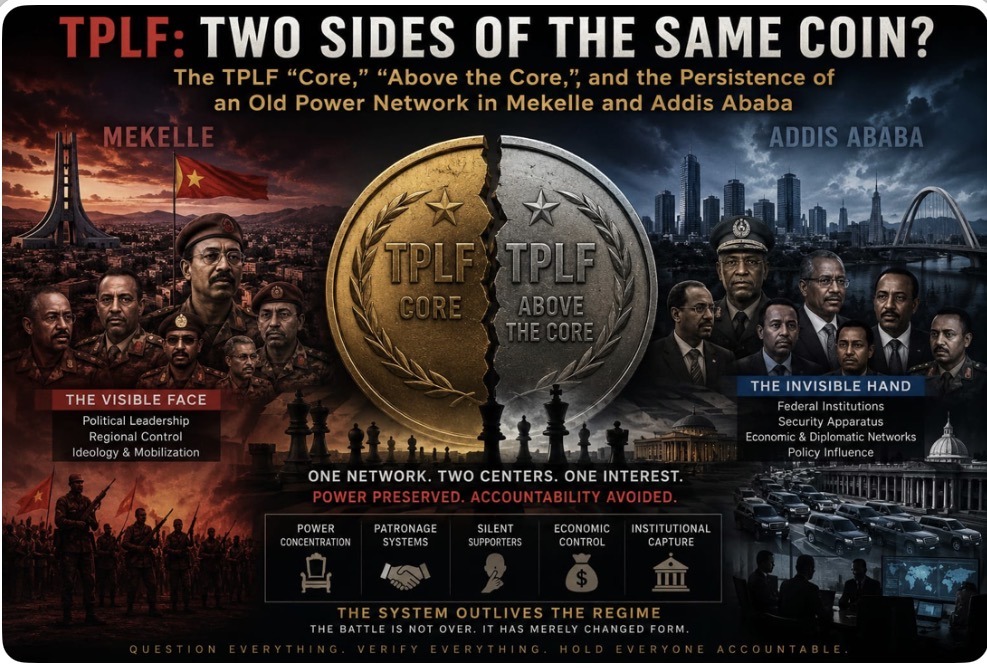
An Investigation Beyond the Visible Political Theatre as an analytical framework for examining post-TPLF elite networks, institutional continuity, political patronage, and the challenges of post-war state-building in Ethiopia and Tigray.
In post-conflict politics, the most consequential power networks are not always the ones speaking the loudest. Some operate openly through political parties, public institutions, and media platforms. Others survive through relationships built over decades: former military command structures, intelligence networks, business interests, diplomatic contacts, retired officials, political patrons, and personal loyalties.
This investigation examines a central question:
Did the political defeat and institutional displacement of the TPLF after 2018 actually dismantle the networks through which its former political and military elite exercised influence—or did significant elements of that network simply adapt, relocate and rebrand themselves?
The question deserves serious investigation rather than partisan slogans.
For nearly three decades after 1991, the TPLF occupied the commanding position within the EPRDF coalition that governed Ethiopia. During that period, Tigrayan officials and military officers occupied numerous senior positions across the federal security apparatus, diplomacy, public administration, and state institutions.
We should not confuse that historical reality with collective responsibility. Tigrayan identity does not prove TPLF allegiance, and service under an EPRDF government does not imply wrongdoing.
The real issue is institutional:
Which individuals, networks and structures retained political, economic, military or informational influence after the old system began to unravel?
That is the investigation.
1. The Central Thesis
The TPLF did not exist only as a political party that governs for nearly three decades and does not disappear simply because its formal political position changes.
It leaves behind:
- personal networks,
- institutional relationships,
- military connections,
- business interests,
- diplomatic contacts,
- former officials,
- intelligence relationships,
- administrative loyalties,
- economic beneficiaries,
- political sympathisers,
- ideological constituencies
- and institutional habits developed over generations.
That is why the distinction between the formal TPLF organisation, and the wider TPLF-era power ecosystem is essential.
The investigation therefore focuses on what may be described analytically as the “Core” and “Above the Core” networks—not as legally established criminal organisations, but as terms for examining senior political, military and institutional circles alleged to have retained influence after the formal political order changed.
The fundamental question is not “Are all former TPLF officials TPLF supporters?” They are not.
The more serious question is: Which former officials and networks continue to defend the political assumptions, institutional privileges and strategic interests associated with the former order—and why?
2. Mekelle and Addis Ababa: Two Theatres, One Historical Network?
The political geography matters. Mekelle became the principal political and administrative centre of Tigray. Addis Ababa remained the federal political, diplomatic, military, and economic centre of Ethiopia.
During the TPLF/EPRDF era, influence operated across both spaces. Senior officials, military commanders, administrators, diplomats, and economic actors developed relationships that did not necessarily disappear when political circumstances changed.
Consequently, contemporary political analysis should not examine Mekelle and Addis Ababa as completely separate political ecosystems. The harder question is whether parts of the old network continue to operate across both.
If so, the mechanism may no longer resemble the centralised command structure of the past.
It may instead operate through:
- relationships rather than institutions,
- influence rather than formal authority,
- access rather than official position,
- political messaging rather than direct command,
- and elite solidarity rather than organisational membership.
That distinction is crucial.
3. The “Silent Supporter” Problem
One of the most difficult subjects in political investigation is the silent political constituency. A person does not have to publicly declare allegiance to the TPLF to defend elements of its historical political order.
A political actor may describe himself as:
- an opposition figure,
- an independent nationalist,
- a reformer,
- a peace advocate,
- a critic of the current government,
- or even an opponent of the TPLF leadership.
While simultaneously defending institutional arrangements, elite privileges or strategic assumptions inherited from the previous system. This produces a political phenomenon worth investigating opposition in language, continuity in interests. That does not automatically prove conspiracy. It does, however, justify scrutiny.
The relevant question becomes when political rhetoric changes, do political interests change with it?
4. The Generals and the Question of Institutional Continuity
The Ethiopian military establishment underwent major changes after 2018. A significant number of senior officers associated with the previous political era were retired, reassigned or removed from influential positions as the federal government attempted to restructure the security sector. But institutional restructuring does not automatically erase institutional memory.
Senior officers who served together for decades may retain:
- professional relationships,
- personal loyalties,
- shared experiences,
- strategic perspectives,
- informal communication channels,
- and common interpretations of national security.
These relationships are inherently legitimate. The danger arises only if private networks become substitutes for constitutional institutions.
Therefore, the central investigative question should be: Did the post-2018 security-sector reforms end political patronage, or did portions of the former elite network survive through retirement, reassignment, informal influence, and political alliances? This question requires documentary evidence, not speculation.
5. The Names That Require Investigation—Not Prejudgment
Various former and retired Ethiopian military officers have been cited in political discussions concerning the TPLF/EPRDF-era security establishment.
Among the names raised for examination are:
- General Samora Yenus
- Major General Mehari Zewde Gebremariam
- Major General Fiseha Kidanemariam, reportedly known as “Maichle”
- General Gebremichael Beyene, reportedly known as “R”
- Lieutenant General Mola Hailemariam
- Brigadier General Mulugeta Berhe
- Major General Mohammed Isha Zeynu Tiku
- Gebrewahd Hailu, reportedly known as “Wedi Guay”
- Lieutenant General Yohannes Gebremeskel Tesfamariam
These names should not be treated collectively as proof of criminality, conspiracy or continuing TPLF membership.
Instead, each individual should be subjected to the same investigative standard:
- What position did the individual hold?
- What decisions did the individual participate in?
- What institutional relationships did the individual maintain?
- What political or economic interests did those relationships serve?
- Did the individual publicly support or oppose the TPLF leadership after 2018?
- Did the individual’s political position change when circumstances changed?
- What documentary evidence exists concerning continuing political networks?
- What allegations have been made, by whom, and what independent evidence supports or contradicts them?
That is how an investigation becomes credible.
6. The Patronage Question
The most serious criticism of the TPLF/EPRDF period concerns not ethnicity but political patronage and institutional concentration. Critics have argued that political loyalty frequently became intertwined with access to state institutions, economic opportunities and administrative power.
The alleged mechanisms included:
- appointments based partly on political loyalty,
- preferential access to economic opportunities,
- politically connected business structures,
- administrative control over land and development resources,
- concentration of decision-making authority,
- weak institutional checks and balances,
- and the fusion of party, state and economic interests.
The existence and scale of these practices must be established through evidence in each case.
But the institutional principle is straightforward: A democratic state cannot function properly when political loyalty becomes more important than institutional accountability.
7. Effort and the Politics of Economic Power
The Endowment Fund for the Rehabilitation of Tigray (EFFORT) has long occupied an important place in discussions about the relationship between politics and economic power during the TPLF era. Observers and critics have argued that the broader TPLF-linked economic model blurred the boundaries between political organisation, state power, and commercial influence.
Supporters and defenders of the system have offered different interpretations.
The proper investigative question is therefore not simply whether EFFORT or affiliated enterprises existed.
It is what institutional safeguards existed to prevent political influence from becoming economic privilege?
And were public resources, regulatory authority or political access used in ways that disadvantaged independent economic actors?
These questions should be examined through corporate records, procurement records, land allocations, regulatory decisions, financial documentation, and testimony.
8. The Status-Quo Defenders
Every entrenched political system produces beneficiaries. When the system changes, those beneficiaries have an incentive to resist transformation. This does not necessarily make them conspirators.
But it can make them status-quo defenders. Their behaviour can be driven by several forces:
- Inertia—The old system is familiar.
- Fear—Institutional change threatens established networks.
- Privilege—Political and economic advantages may be lost.
- Identity—Former political loyalties can become deeply personal.
- Institutional Memory—Old relationships continue even after formal structures disappear.
- Self-Preservation—Individuals may resist accountability because accountability threatens their reputation, wealth, or influence.
That is why political transition is rarely completed simply by changing officeholders. Institutions must change. Incentives must change. Accountability must change.
9. The “Opposition” Question
A particularly important investigative problem concerns individuals who present themselves as opponents of the current TPLF leadership while continuing to defend elements of the old political order.
Again, opposition to the current TPLF leadership does not automatically make somebody a genuine democratic reformer. Nor does criticism of the TPLF leadership automatically make somebody an enemy of TPLF ideology. The distinction must be established through behaviour.
A serious investigation should compare what they say against what they defend and ultimately against what they do.
That is the only reliable test.
10. The Red Sea Question
Few issues demonstrate the difference between political mythology and strategic analysis more clearly than Ethiopia’s relationship with the Red Sea. Ethiopia’s loss of direct sovereign access to the sea following Eritrea’s independence in 1993 remains a major strategic issue in Ethiopian politics.
Critics of the historical TPLF/EPRDF leadership have argued that the post-1991 political settlement failed to adequately protect Ethiopia’s long-term maritime interests. Others reject this interpretation and point to the political and legal realities surrounding Eritrean independence and subsequent interstate relations.
The issue, therefore, deserves evidence-based examination rather than retrospective political mythology.
The strategic question is how should Ethiopia pursue legitimate maritime and commercial interests while respecting international law, sovereignty, and regional stability?
This question belongs to Ethiopia’s future—not merely to arguments about its past.
11. The Tip of the Iceberg
The visible political confrontation may represent only a small portion of the underlying problem. The “tip of the iceberg” metaphor is useful because political influence is rarely confined to formal organisations.
Below the visible surface may exist:
- retired officials,
- former military officers,
- business networks,
- political intermediaries,
- diaspora organisations,
- media ecosystems,
- informal advisers,
- diplomats and diplomatic relationships
- ideological constituencies,
- and competing factions within the same historical political movement.
But an iceberg cannot be mapped through suspicion. It must be investigated thoroughly. This means following money, appointments, communications, institutional relationships, corporate ownership, political alliances, public statements, and documented decisions.
12. The Most Important Distinction: Tigrayans are not the TPLF.
Any serious investigation must draw an absolute line between Tigrayan identity and political affiliation. Millions of Tigrayans did not support the TPLF nor control the Ethiopian state. Millions did not participate in TPLF decision-making. Many opposed the TPLF. Others supported it through personal political and economic interests. The majority simply lived under the political system.
Collective blame is, therefore, intellectually lazy and politically dangerous.
The investigation should target:
- individual decisions,
- institutional structures,
- political organisations,
- documented networks,
- and specific allegations supported by evidence, not ethnicity.
13. The Real Conspiracy Question
The word “conspiracy” is powerful—and therefore dangerous when used carelessly.
Before describing an individual as a conspirator, investigators should establish:
- Coordination—Did the individuals communicate or cooperate?
- Common objective—Was there a demonstrable shared purpose?
- Action—Did they take concrete steps toward that objective?
- Evidence—Are there documents, communications, financial records, or credible testimony?
- Intent—Can intentional conduct be distinguished from coincidence or ordinary political disagreement?
Without those elements, “conspiracy” becomes rhetoric rather than investigation.
14. The Deeper Question: Who Benefits?
The most powerful investigative question in politics is often the simplest:
- Who benefits?
- When a political network opposes reform, ask who loses if reform succeeds?
- When an institution resists transparency, ask who benefits from secrecy?
- When political factions suddenly reconcile, ask what interests brought them together?
- When an alleged opponent suddenly defends an old institutional arrangement, ask what changed their principles or their incentives?
- When political rhetoric becomes increasingly hostile, ask who benefits from polarisation?
These questions turn political commentary into investigative analysis.
15. From Personalities to Systems
The greatest mistake would be to reduce this investigation to a list of individuals. The deeper issue is institutional. If the TPLF-era political system produced networks of patronage, political dependency, and concentrated influence, then replacing individual personalities without dismantling those mechanisms would accomplish little.
The objective should, therefore, not be revenge. It should be institutional reconstruction.
That means:
- independent institutions—Political parties must not control state institutions.
- professional security forces—Military and intelligence institutions must serve the constitution rather than political factions.
- transparent public finance—Political networks must not determine access to public resources.
- competitive economic institutions—Political connections must not substitute for lawful competition.
- independent judiciary—Allegations of corruption or abuse must be tested through evidence and due process.
- democratic political competition—Opposition must mean more than changing which faction controls the same machinery.
16. The Real Post-Tplf Test
The real test of political transformation is not whether the TPLF remains in power or is removed from power. It is whether TPLF-style politics loses its institutional foundations.
That means moving beyond:
- personality politics,
- military politics,
- patronage politics,
- ethnicised political competition,
- elite monopolies,
- opaque economic networks,
- political intimidation,
- and institutional capture.
The post-TPLF political order that simply reproduces the same habits under different personalities is not genuine political renewal. It is merely regime recycling.
17. Final Assessment
The most important conclusion of this investigation is, therefore, deliberately uncomfortable: the question facing Ethiopia and Tigray is not simply what happened to the TPLF.
The larger question is what happened to the networks, incentives, institutions, and political culture that made TPLF-era dominance possible in the first place?
Some individuals may have genuinely changed. Some may have become reformers. Some may have remained committed to the old ideology. Some may have become political opponents of the current TPLF leadership while retaining elements of the old political worldview. Others may simply have withdrawn from politics.
Only evidence can distinguish these categories. That is why the next generation of investigation must move beyond slogans such as “TPLF supporter”, “TPLF opponent”, “hardliner”, “reformer”, or “conspirator”. Those labels are conclusions. They should not be the starting point.
The starting point must be following the money, appointments, institutional records, military careers, corporate relationships, political statements, decision-making documents, and independently corroborated testimony.
The objective is not to manufacture another political enemy. The objective is to identify whether an old system of power has genuinely ended—or whether parts of it have simply learned how to survive without wearing the same uniform.
18. The Final Question
The most consequential question for Ethiopia and Tigray is not, therefore, “Who still supports the TPLF?”
It is much more demanding: “Which political, military, economic and institutional networks still benefit from the legacy of the TPLF-era system—and what evidence can establish the extent of their continuing influence?”
That is where serious investigation begins.
And that is where political accountability must ultimately end: not with collective blame, but with evidence, individual responsibility, institutional reform, and the rule of law.